



Ecommerce Product Data Requirements: What You Need to Build Trustworthy Listings
Ecommerce product data is the set of facts your business holds about each item you sell, and every listing you publish is built from it. To build trustworthy listings, your system of record needs a unique SKU, brand and identifiers, factual descriptive details, images, price and stock, logistics data and, for some categories, extras such as fitment or compliance information.
Exactly which fields a listing must carry depends on the channel and the category. The goal of your source data is simpler: capture accurate facts once, in one place, so every channel can draw on them.
Key Takeaways
- Ecommerce product data starts in your system of record, not on a marketplace. Listings are outputs; the source record is what you maintain.
- Core source data covers identity, descriptive facts, media, offer and logistics data, variation relationships and category-specific facts.
- Requirements are not universal. Amazon, eBay, Walmart, Shopify and Google Merchant Center each set their own rules, and they vary by category.
- Facts such as identifiers, dimensions and fitment have to come from a manufacturer, a supplier or your own measurements. Software can check and format them, but it cannot invent them.
What Is Ecommerce Product Data?
Ecommerce product data covers SKUs, brand names, identifiers, specifications, descriptions, images, prices, stock levels and shipping details. For parts sellers, it also includes fitment data such as Year/Make/Model compatibility.
Every detail a shopper sees on a listing started as one of these facts. When the facts are complete and accurate, the listing answers the buyer’s questions before they have to ask.
Source Data vs Channel Listings
It helps to separate two layers. Your source data is the master record in your ERP, product information management (PIM) system or multichannel platform. A channel listing is a version of that record shaped for one marketplace or storefront.
When the source record is right, a fix made once can flow to every listing built from it. When teams edit listings directly on each channel instead, the versions drift apart and nobody is sure which one is correct.

The Source Data Your System of Record Should Hold
Think of the source record as the facts you would need to answer any channel’s questions about a product. Most catalogs group them into six areas.
Identity Data
- SKU: one unique internal code per product or variant, never reused.
- Brand and manufacturer part number (MPN): spelled the same way on every record.
- Product identifiers such as GTIN or UPC: store the ones the manufacturer assigned. Many channels ask for them in many categories, while some allow exemptions, so check each channel’s rules for your category.
Descriptive Facts
Store the facts that titles and descriptions are written from: product type, materials, dimensions, color, size, capacity, what is in the box and how the item is used.
Keep these as separate, structured values rather than burying them in one long description. A structured “material” or “length” value can be reused on any channel; a sentence in a paragraph cannot.
Media
Keep high-resolution original images, plus any manuals, spec sheets or videos you have. Image standards (background, size, number of photos) differ by channel and category, so store the best original and let each channel version be derived from it.
Offer and Logistics Data
- Price inputs such as cost, MSRP or MAP where they apply, and your selling price.
- Quantity on hand, ideally per warehouse or location.
- Item condition (new, used, refurbished).
- Package weight and dimensions, which drive shipping rates and fulfillment.
Variation Relationships
If a shirt comes in five sizes and three colors, your source data should record which child SKUs belong to which parent and which attribute (size, color) makes each one different. Without that relationship, channels cannot group the options into one listing.
Category-Specific Facts
Some categories need data that others never ask for. Examples include:
- Automotive and powersports parts: fitment data, often structured with ACES (Aftermarket Catalog Exchange Standard) and PIES (Product Information Exchange Standard), and eBay EPIDs (eBay Product IDs) on eBay Motors.
- Regulated or sensitive products: safety, hazardous materials, age or compliance information, where a channel’s category rules call for it.
- Apparel and consumer goods: sizing systems, care instructions or materials composition.
Capture these only for the categories you sell in, and capture them from an authoritative source.
Why Requirements Depend on Channel and Category
There is no single list of required fields that applies everywhere. At the time of writing, the big channels handle this differently:
- Amazon sets category-specific listing requirements and style guides.
- eBay asks for item specifics that vary by category, with extra compatibility data in eBay Motors parts categories.
- Walmart Marketplace uses item specs that depend on the product type you list.
- Google Merchant Center asks for product identifiers where they exist, among other attributes.
- Shopify and other storefronts let you decide most fields yourself, though your theme and filters depend on structured data.
These rules change, so treat this as a general picture and check each marketplace’s seller documentation for the exact category you list in.
Required vs Recommended, in Brief
Each channel splits its fields into ones it needs to accept a listing and ones it suggests for better filtering and shopper confidence. Your source data does not need to mirror those labels. It needs to hold accurate facts, so that whatever a channel asks for in a given category can be filled from the record instead of guessed at.
Where Good Source Data Comes From
The most reliable product facts come from the people closest to the product:
- Manufacturers: identifiers, specifications, images and, for parts, ACES and PIES files.
- Suppliers and distributors: feeds with cost, stock and product details.
- Industry data providers: for automotive sellers, sources such as SEMA Data, DCI or the ASAP Network.
- Your own team: measured weights and dimensions, original photos and verified condition notes.
Scraping specs from other websites is a poor substitute. The data arrives unstructured and unverified, and it can break a site’s terms of use or copyright.
Give Every Field One Owner
When purchasing, marketing and fulfillment all keep their own version of a product, records drift. Agree on one owner per field: purchasing for cost and supplier data, marketing for copy and images, operations for weights and dimensions.
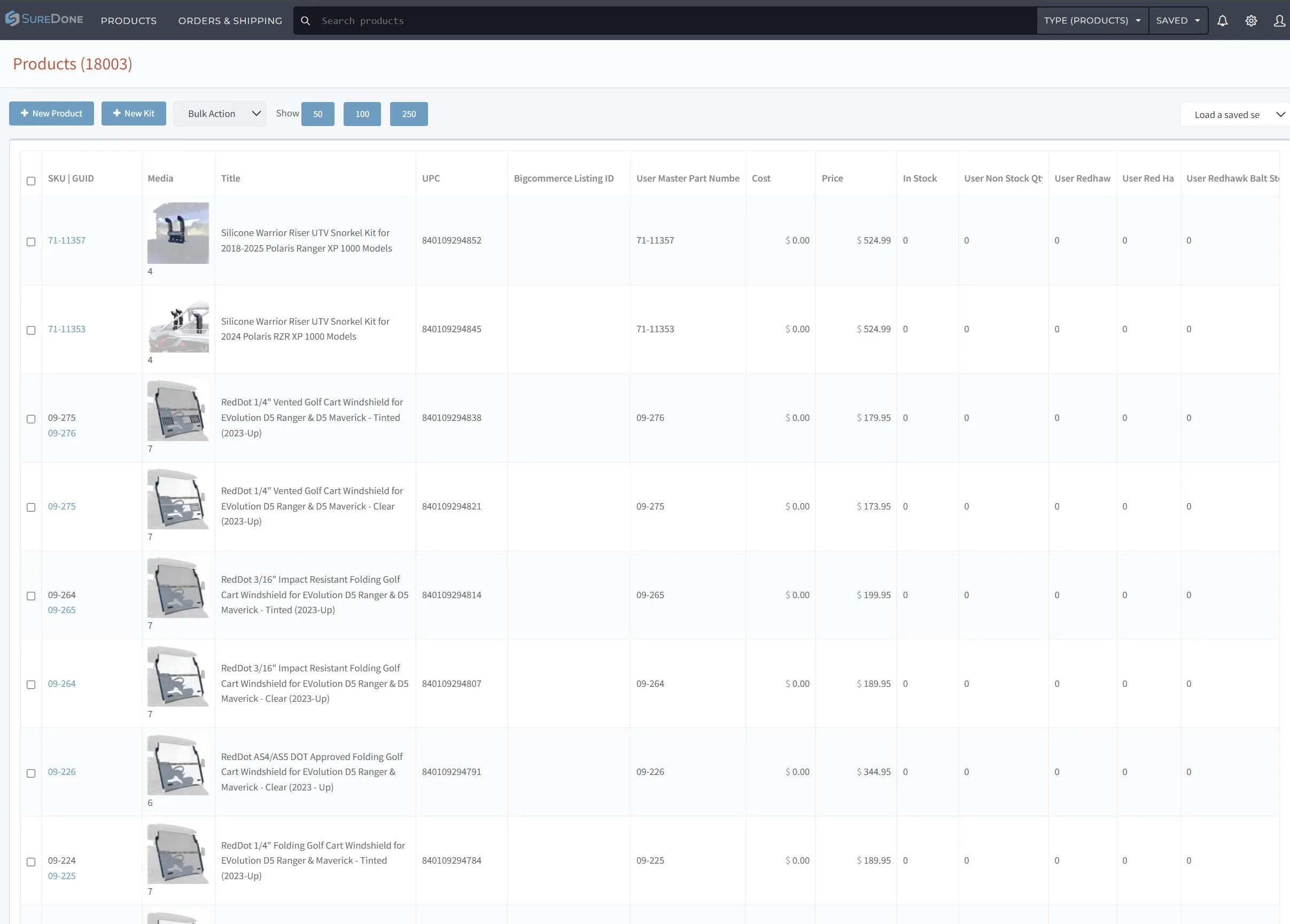
The SureDone product list: one record per SKU, with identifiers, price and stock, that every connected channel draws from.
Keeping Source Data Clean
Clean source data saves you from fixing the same error on every channel. Before you connect a new channel, work through the basics:
- Remove duplicate SKUs and merge their history.
- Standardize units (inches or centimeters, not both in one field).
- Fix inconsistent brand spellings.
- Correct identifiers with invalid check digits.
- Use a fixed list of values for fields such as color or condition, instead of free text.
Channel Mapping, in Brief
Once your source fields are structured, each channel field can point to one attribute in your record, with value translations where a channel uses different terms. The cleaner and more structured the source data, the less mapping work each new channel takes.
Readiness Checks, in Brief
Before publishing, a readiness check compares a record with what a channel asks for in that category and lists the gaps. The fix belongs in the source record, so it reaches every channel that uses it, not only the one that flagged it.
A Practical Source Data Audit
If your catalog lives in spreadsheets, supplier files and old listings, a short audit shows where you stand:
- Pull every product record into one view, with its source noted.
- List the channels and categories you sell in, and note what each asks for in that category.
- Mark which facts you hold, which are missing and which came from an unreliable source.
- Request missing identifiers, specs and fitment from manufacturers or suppliers.
- Clean and consolidate the records in your system of record before you publish anything new.
The audit matters most. A fact that was never captured cannot be mapped, checked or optimized later, by a person or by software. For more on why accurate details matter to shoppers, see this guide to building trust with consumers.
Frequently Asked Questions About Ecommerce Product Data
What product data do I need to sell on marketplaces?
At a minimum, most channels need a SKU, title, description, category, images, price and quantity. Beyond that, requirements depend on the channel and the category, such as identifiers, item specifics or fitment. Check each marketplace’s seller documentation for the category you list in.
Are product data requirements the same on every channel?
No. Amazon, eBay, Walmart, Google Merchant Center and Shopify each set their own rules, and those rules vary by category and change over time. Keep accurate facts in one system of record so you can meet each channel’s rules from the same data.
How can I find free ecommerce product data?
Public datasets can be useful for testing or analysis, but for selling you need data from manufacturers, suppliers or your own team. Scraped data is often unverified and can violate a site’s terms of use or copyright.
What is the difference between product data and product content?
Product data is the structured facts, such as SKUs, dimensions, identifiers and prices. Product content is the persuasive layer built from those facts: titles, descriptions, images and video. Trustworthy listings need both.
Can AI fill in missing product data?
AI can help optimize titles and descriptions and flag gaps in a record. It cannot supply facts that only a manufacturer or supplier holds, such as identifiers, exact dimensions or fitment. Those still need to come from an authoritative source.
How SureDone Helps
SureDone® is a multichannel e-commerce platform that gives you one catalog to act as your system of record, connected to channels such as Amazon, eBay, Walmart and Shopify. You can bring supplier and spreadsheet data in with Bulk Upload & Export, and parts sellers can work with ACES, PIES and data providers such as SEMA Data. A fact you correct in the catalog can then be reused on every connected channel.
On top of that catalog, SureDone AI Listing, powered by Taska AI, optimizes titles and descriptions, proposes category and field mappings, flags readiness gaps and builds a scoped listing plan. Every publish or end action stays behind your approval, each channel outcome is verified separately, and it works only with the facts your catalog already holds.
Want to see it with your own product data? Request a demo.
